Little by little the camel goes into the couscous...

30 March 2011

The Call to Prayer: How Time Moves You in Morocco

The adhan, or call to prayer, is a unique facet of life in a Muslim country. In the Fes medina, where there's always a mosque around the corner, the adhan is unavoidable.

At home or in the streets at prayer time you hear a soft hum in the distance that crescendos steadily until a hearty "Allahu Akbar" blares from the nearest minaret. At first it is disarming, especially to Westerners unaccustomed to or unaware of prayer's central role in Islam. But after a few days or weeks, it, like everything else in Morocco, it assimilates into your life and you either respect it as an expression of Muslim piety, scorn it as an unwelcome early morning wake up call, or simply ignore it.

The call to prayer preludes each of the daily prayers that are included among the 'pillars' of Islam. There are five in total spread throughout the day: fajr occurs in the early morning before sunrise, dhuhur at midday, 'asr in the mid-afternoon, maghrib at sunset, and 'isha at night. The call is recited by a muezzin, literally an 'announcer', who traditionally would shout the adhan from the top of his mosque's minaret or in the streets. Today, most mosques are equipped with loud speakers.

In traditional Muslim societies, prayer times used to demarcate the different phases of the day. The phrase 'ba'd dhuhur' in classical Arabic translates to the English word 'afternoon', and literally means 'after dhuhur prayer'. In this sense, the 'afternoon' did not begin until dhuhur prayer was performed. The classical Arabic word for 'dinner' shares its root with 'isha, the last prayer of the day. Remnants of this influence on daily life can still be seen in the old medina. During the week, many shops close between dhuhur and 'asr prayers, and on Fridays, the Muslim holy day, a vast majority of businesses are closed as Moroccans take the afternoon off after their communal dhuhur prayers.

In many ways, this role of the adhan represents a different psychology about time, and our relationship to it. Last night at dinner my roommates, our guests and I had a conversation about the differences between religious time and the secular time. My roommate Chris explained how in the 19th century, governments in Europe began to use churches to signal the official beginnings and ends of the workday.

In that period, church bells were the most effective means of communicating information, especially in the agrarian countryside where farms and farmers were scattered over miles. Before these initiatives, churches used their bells for purely religious purposes, signaling religious holidays such as Christmas and Easter, as well as the hours for daily prayers. Much like prayer in Islam, Christian prayers determined the pace of daily life. By secularizing church bells, these governments not only stripped them of their sacred functions but also initiated a shift in the human relationship with time.

The key issue here is control.

Who controls time? In the religious sense, God controls it. When time is sacred, it cannot be controlled by people because then it ceases to be sacred. As a result, time is something we must obey. During Ramadan, Muslims cannot eat or drink between the pre-dawn (fajr) and sunset (maghrib) prayers. Because Islam uses a lunar calendar, this means that some years Ramadan falls during winter, and others it falls in the summer. The length of the Ramadan fast may be longer or shorter from year to year, but the rules do not change.

By secularizing time, people gained control over it. A day's length was standardized; the length of an eight hour work day does not change depending on the season. To regulate something is to control it. People now 'made' time instead of yielding to it.

I think we can see the influence of these points of view when we compare cultural conceptions of time in Morocco and the United States. In Morocco, time is view neither as rigid nor controllable. People arrive at their appointments when they arrive. Shops open when they open and close when they close. This morning I asked my dairy guy when he will have cheese. He said, "we'll have it when the cheese guys make it."

In the United States, and other Western countries, most people view time differently. Because we control time we possess it, and so we can 'make use' of it. If you do not 'make use' of 'your' time then you are 'wasting it.' We emphasize punctuality as well, so that we don't 'waste' the time of our friends or colleagues. If we are busy we can always 'make' time to see someone. And we mustn't let time 'slip away.'

At dinner, one of our guests asked Chris and I if we thought the adhan would ever change to announce secular time just as church bells had changed two centuries ago. We both said no. As Chris pointed out, it's easier to appropriate an object like a bell and change it's purpose than it is to change the purpose of a whole class of people. Additionally, I said that I didn't think such a shift could be justified in a Muslim context.

Thinking more broadly, the secularization of time has broad cosmological implications. If man controls time then he, to some extent, controls the universe. Or he at least considers the universe to be controllable (I think contemporary views about science's potential to tame nature are sufficient evidence of this point). To a Muslim, God controls the universe, and anything otherwise is unacceptable. That's not to say that Islam and rationalism are mutually exclusive, but rationalism to the point of replacing God with man is.

I can't imagine the Fes medina without the traditional adhan. If it were to change, and the blaring "Allahu Akbar" were to change to a cacophonous "It's now 12:00pm", it would lose all of it's meaning. What was once a rich symbol of Morocco's religious heritage and maintenance of tradition, would, essentially, become a talking clock.

16 March 2011

Don't go to school unless you want to get beat up

Monday, I published a blog post where I lamented the current strike at my university. At the end of the it, I agreed with the notion that 'people' (read: some Moroccans) don't take school seriously, that this was just an instance of political grandstanding to masquerade the strikers' desire to shirk their studies.

While it is true that some of the Riffaqis and Ikhwanis, and even more of their supporters, are looking for a way to avoid their responsibilities as students, it is unfair to cast their motivations as entirely trivial. These strikes are taken very seriously. Organizers use intimidation to keep students out of class. I witnessed this last October. Fights are common. Strikers also threaten violence against students who challenge their motives and tactics.

Last night I witnessed this exchange* on a Facebook group created by my university students:
Ahmed: tomorrow you must back to study ...

Mohammed: really !!!

Ahmed: yes. we have to talk with the strikers and tell them we want to study

Mohammed: who said? i have just heard that classes will start next week.

Ahmed: yes, that is why.

Mohammed: but we will just waste time with that fucking people there. we should be patient this year.

Ahmed: we are going trough hell!

Mohammed: yeah !!! but what shall we do this is Morocco

Ahmed: no, no

Mohammed: yes !! mate. this is Morocco everywhere u go u will find same drama

Ahmed: the strike yes, but not in the time of studying. we need our right yes but there are some duties

Mohammed: what duties are you talking about?

Ahmed: tomorrow i will go to tha fucking university and i will tell them to stop that that's enough. lets us start the semester, there is time for doing this out of study. Our duties?studying and geting very good mark and trying to produce some thing for our beloved country

Mohammed: u cant' do it only by urself we need all students attend but unfortunately u can't collect them all
we have over 300 students in our class and when u want to talk about problems which they suffer from u will find just 5 students or maybe just 2
so i advise u bro to keep away

Ahmed: thx

Mohammed: cuz if they saw u only who speaks about that they will do something bad to you
. plzzzz don't speak alone

Ahmed: ok thx, brother


Mohammed: i still remember last time when you talked during the class at infor... 
fortunately you found support for ur words then


Ahmed: yes , i did


Mohammed: if you go tomorrow and they are not brave students like you, u will find urself out of university

I mentioned the strike to a colleague of mine today. He told me: "You are witnessing a crumbling system." The causes of such are varied and disparate. You can't blame the Ministry of Education. Some universities are more functional than others. The educational reforms are good and well-intended, but so far exist only on paper. You can't blame individual administrations either; the system they're asked to implement is a far-fetched ideal. To compound an already complex problem, the day-to-day operations of the university are impeded by the student unions. Yet, they are only asking for what the law promises them.

In the middle of these competing interests are the students. What if I never teach again this semester? The government and administrations would blame the student unions. The student unions would blame the government and administrations. Would they recognize the damage they caused by setting students back? How do you make up a lost semester?

For over a decade, Morocco has struggled to improve it's higher education system. What will the results of these efforts be? A generation of young minds lost, their futures forfeited for what? A brighter but more distant future? How will this lost generation participate in it?

Previously, I labeled Morocco's higher education system as dysfunctional. But now, after seeing how it schemes to subvert even the best students' desire to study, I can only call it a disaster.

*Edited for content and to preserve the anonymity of the conversation's participants

14 March 2011

Back to school (almost)

This morning I returned to the university to begin the Spring semester. Last night I was busy preparing my notes, trying to tap into the teaching mojo I built up in the Fall. It's been a long time since my last class. I last taught on December 21st, 2010,  and this wasn't a 'true' class, I only listened to students deliver oral presentations. I delivered my last lecture the first week of December. So this morning, on my way to campus, I was a little nervous. It's amazing how much we can forget after three months.

To a certain extent, my nerves got the best of me. My lecture was rigid, I found myself explaining information that I could have evoked from my students, the questions I asked were poorly worded, either too obvious or too abstract. I could sense my struggles, so I reverted to my natural defense mechanism: sarcasm. The only problem is that sarcasm doesn't work with first year university students with only a few semesters of English study under their belts. So with every joke that fell flat I grew increasingly anxious. The notes I had prepared evaded my memory, and I just kept stumbling along, worried about how I would fill the remaining 2.5 hours of class.

Thankfully, I was saved. 45 minutes into my lecture, my class welcomed some very special visitors. My good friends, the Riffaqis (the Comrades, or the Socialist Students Union), had returned to liberate my students from their oppressed states.

The moment they walked in I knew what they wanted. I let their leader speak to my class. My students listened attentively to him explain the purpose behind the protests and demonstrations. But they kept their notebooks open, pens at the ready. They seemed bored by a speech they've probably heard dozens of times. For a moment, I felt like they wanted him to shut up quickly so we could get back to class. And then he said the magic words (which I didn't understand), flicked his wrist, and my students, smiles beaming, packed up their bags and left class. I guess they didn't want to study after all.

---

Morocco has not been immune to the unrest affecting the entire Middle East and North Africa region. February 20th was the nation's 'day of anger', and many Moroccans took to the streets in protest of government corruption and socioeconomic stagnation. To be true, these demonstrations were much smaller and less energetic than those that initiated the revolutions in Egypt, Tunisia and Libya, and there has been little unrest since February 20th. Nonetheless, the concerns voiced by Moroccans on that day are legitimate, so much so that King Mohammed VI delivered an historic speech last week initiating major political and social reforms, including a "deep revision" of the constitution and a reduction of his executive powers.

What does this have to do with the university? Moroccan universities, like those in most countries, are centers of political activism. Two student groups, the Ikhwanis (Islamists) and the Riffaqis, dominate campuses all across the country, organizing protests and demonstrations whenever they see fit. These are not "student groups" like the chess club or the dance team, they are more like labor unions of old. Violence is common (there was a knife fight between the Ikhwanis and Riffaqis during final exams at my university) and it's not uncommon for the government to call in their Pinkertons (aka the police) to break up prolonged student strikes

There is no doubt these student groups have been anxiously awaiting their opportunity to capitalize on the February 20th protests. Starting a general strike on the first day of the new term sends one message to the Ministry of Education: promises are great, but we want what is ours now.

I knew the strike was coming. Yesterday I met with a student who told me I shouldn't get too excited to teach this week. But I didn't want to believe it. For all intents and purposes, I've been on a three month vacation. At this point in the year, I've spent more time out of school than in, and maybe that will continue. And while vacation is nice, that's not why I'm here. I'm here to try my damnedest to be an English teacher. I also crave the routine. It feels good to wake up in the morning with a sense of purpose, to go to class and return with a sense of accomplishment, however minor it may be. For now, I must wait to get back to that.

As I left the university this morning, a friend of mine passed a long a pearl of wisdom he heard from one of his teachers. It describes the school year in Morocco: "In Morocco, the school year is comprised of vacation which is cut off my intermittent time in class." When I described what happened this morning to a different friend of mine, she quipped, "who doesn't want a day off?"

From what I've seen so far this year, I can't help but agree.

17 February 2011

Reflections on a Revolution

I was sitting on the upstairs patio of Cafe Imilchil in Errachidia, enjoying a cafe niss-niss, when the waiter came upstairs to turn on Al-Jazeera. Something was different this time. Rather than frantic desperation, the announcer spoke with a sense of joy. The TV showed the same crowds as it had for the past two weeks, but mixed in with the shouts and chants was the sound of singing. The ticker read: "People throughout the Arab world, from the Atlantic to the Gulf, celebrate the fall of Mubarak's regime." My Arabic is not good enough for me to trust it at first glance, so I read it again and then asked a Moroccan nearby to confirm the news. My friend, a fellow Fulbright ETA, said this to me: "We'll always remember where we were when we heard this news."

The Egyptian Revolution was an undeniable turning point in history. While it remains in its nascent stages and the outcome is unclear at best, there is no way to ignore its importance to the Middle East and to the world.

Since September, I've lived and worked in a country similar to Egypt. Morocco is poor, Arab, Muslim, and not really a democracy. In many ways the Egyptians who protested are no different than the men and women I work with, see on the street, and sit next to in cafes. They have similar backgrounds and aspirations. And though I believe Morocco will remain a stable country and not experience any major change in government, it would be wrong to think that Moroccans are disconnected from the events that happened in Tunisia and Egypt. Everywhere you go people are watching Al Jazeera, listening to the news on the radio, or reading a newspaper.

One night during the first week of protests I went to a cafe near my house to have a coffee and watch the news. Even then, I felt a tangible energy in the place, as if at any moment Mubarak could fall. More than that, I knew everyone else, in Egypt, on television and in the cafe was feeling and thinking the very same thing.

During that night's coverage, they showed a video of a large SUV driving through a crowd of protesters near the American and British embassies in Cairo. The men in the cafe threw up their hands, shouting at the television. On each replay they would nudge their neighbors, wide-eyed, furious. They, like I, were disgusted by such a wanton and violent act against those people, no longer mere protesters. It was a powerful and essentially human moment.

This intense humanity drew me back to the television and newspaper throughout the protests. I was familiar with the various political implications, especially to America's foreign policy. I was interested in pundits' opinions and prognostications, but more so I read and I watched because of the drama. This was human drama to its fullest extent playing out on television: a poor, down trodden people set aside their social, political and religious differences in a united act of revolution; humanity pushed to its extreme pouring in through the television screen.

Media has played a huge role in all of this. And while it's popular to boast about the role of Facebook and Twitter in organizing these uprisings, I doubt their impact. Americans inflate social media's role in society because it plays such a big one in ours. There are about 150 million active Facebook users in the United States, or around 50% of the population. In the Middle East/North Africa region there are 15 million Facebook users, or less then 4% of the population. While I believe that Facebook and Twitter are revolutionary in the way they connect people, I can't buy their purported revolutionary influence on the Middle East. Then what is the revolutionary medium? In my opinion it is satellite television, and more specifically Al Jazeera.

Al-Jazeera has broadcast footage of the uprisings from Sidi Bouzid onwards. These images are the most powerful illustrations of the will and determination of the Tunisian and Egyptian people. Revolutions need logistics, organization and planning, but most importantly, they need energy. That energy comes from the pain, suffering, triumph and victory that plays out every night on television. I know this because I've felt it and seen it, and it is infectious. When Mubarak announced his resignation, a friend reported that it sounded like a crazy soccer match; she was listening to the crowds gathered in a cafe watching Al Jazeera.

As the events unfolded, and Egypt got closer to winning its freedom, I kept thinking, "Why don't Americans love this? This is the beauty of democracy: people rising up against oppression to make their voices heard. Shouldn't we love this?"

But America's reaction has been ambivalent at best.

It's well known that the Egyptian Revolution put America in an awkward political position. Sadly, we chose to view these events as such: a radical change to the factors that comprise our desired geopolitical reality. By fretting over "stability", oil prices, and "national security", we've lost the sense of human drama and triumph. We forget that this is a great human accomplishment. We're missing the point. Egyptians fought and died in the streets. They risked their lives to achieve a dream, a collective hope they've been denied their entire lives. What comes of this bloodshed when we we look past it?

These days, our national empathy has enough difficulty transcending party lines, let alone cultural, religious, and socioeconomic differences. And what happens when we increasingly view the world as a series of factors that comprise our "national interest"? Is it easier to empathize when we value abstract principles over ourselves and others?

30 January 2011

Will protests happen in Morocco?

Many Western commentators have written how the revolution in Tunisia sent a "shockwave" through the Arab world. It was the first time an Arab dictator has been removed from power through popular revolt. One article which explained that the ouster of Ben Ali, unlike that of Saddam Hussein in 2003, was something Arabs could "be proud of." Recent protests in Algeria, Jordan and especially Egypt speak to the influence of Tunisia's uprising. And while some are comparing Tunisia to Poland in 1989, and this moment to the beginning of the fall of the Soviet Union, it's a stretch to think we will see the collapse of every authoritarian regime in the Arab world. 

It's been strange to be in Morocco during all of this. There's no lack of information. When you walk into a cafe, people are watching coverage of Egyptian protesters burning police vehicles or tearing down posters of Hosni Mubarak. But these images and ideas don't seem to be penetrating. A glance through two of the biggest newspapers, As-Sabah and Al-Masa', lead you to believe that the protests are only tangentially relevant to Moroccans. There are no attempts to apply Tunisians' and Egyptians' grievances to a Moroccan context. On Facebook, my students have posted pictures of the Egyptian protesters along with words of support and solidarity, and then proclaim their love for Morocco's King Muhammad VI. How can you identify with the protesters of two revolutions against authoritarian governments and still support the authoritarian government that governs you?

Why have the events in Tunisia and Egypt failed to generate the same reaction in Morocco as they have elsewhere in the Arab world?

Reading reports from the past weeks has made it clear to me that life for the average Moroccan is very different than that of a Tunisian or an Egyptian. Yes, Morocco is a poor country with high unemployment. The GDP per capita is significantly lower than Egypt's and nearly half that of Tunisia. Yet, the poverty is not oppressive. Life necessities are cheap in Morocco. People are poor but do not starve. The Moroccan government also tolerates "underground economic activities" which provide money and support for many young, uneducated Moroccans. The most notable of these is the drug trade, which according to WikiLeaks, generates more money than Tourism, the largest sector of the Moroccan economy.

A second, key difference, concerns education. As one commentator pointed out, Tunisia is an exception in the Arab world in that it has a large, educated middle class. The middle class' dissatisfaction with the country's economic prospects fueled the protests that eventually led to Ben Ali's downfall. Egyptians, while not nearly as wealthy as Tunisians, are similarly educated. Both countries post literacy rates in the 70s and both protests movements have utilized social (especially Tunisia) and print media (especially Egypt) for organizational purposes. Morocco is a completely different story.

At best, 50% of Moroccans are literate and many well-educated Moroccans are ex-pats living in Europe or North America. While this may seem insignificant, I think it's a huge factor. Moroccans' illiteracy hampers the spread of information in general, and would definitely impede the organization of any type of protest movement. Additionally, the Moroccans who identify the most with Tunisia and Egypt don't live in Morocco. They've already exercised their discontent by leaving the country. This last point deserves some elaboration.

There is a class of Moroccans who are wealthy and educated and unhappy with the current political system, but their influence on average Moroccan life is unclear. Many comments at English language sites catering Moroccan ex pats living in North America are critical of the political status quo, and since the Tunisian protests has been quite vocal about the need for some sort of change in Morocco. Whether these views are valid or not, they only represent a tiny, and, honestly, insignificant portion of the Moroccan citizenry. These people are both literate and English speakers, which alienates them from about 98% of Moroccans. Additionally, they're ex pats. As one Egyptian commentator wrote, "people remember those who abandoned them in their quest for democracy." In other words, I don't think being centered in North America or Europe helps this opposition's credibility with the Moroccan people.

And this brings me to my last point: there is no credible opposition to the King.

Morocco is a parliamentary monarchy that has a prime minister, political parties and elections. But in reality, it's more like an absolute monarchy. Parliament and the lesser bodies of government are where corrupt officials take bribes and appoint their sons- and daughters-in-law to influential posts. This corruption is obvious and know and derided by the Moroccan people. It's not uncommon for a Moroccan to say that the best way to make money in the country is to get into politics, but that you can only do that if you know the right people.

The King is seen as the only credible member of government despite his overwhelming and unquestionable political powers. And there's good reason for this. Royal initiatives, like infrastructure development and some social reforms, are completed on time and relatively efficiently. In other words, he gets things done when other Moroccan politicians don't. Combine that with the legacy of the Alaouite Dynasty, which has ruled Morocco for nearly four hundred years, and Muhammad VI is seen less as a despot and more as a benevolent and beloved monarch.

Now it's true that the King has the power to end the corruption that plagues parliament, the police and the military. But that serves him no purpose. Allowing his political opponents to profit in their subordinate positions decreases their desire for change. Additionally, their corruption draws the ire and attention of the people, making him look better. So while his policies may leave something to be desired in the eyes of some Moroccans, the alternatives are much much worse.

The commentator who describe Tunisia as an exception in the Middle East may be eating his words in the next few days depending on Egypt's outcome. I may as well when I say that protests will not happen in Morocco. This doesn't mean Moroccans are happy with the state of affairs in their country. Poverty, unemployment, education, and political freedom are just a few issues that Moroccans feel must be addressed. But for now, the situation does not seem dire.

More than anything, Moroccans love stability. This is why they love the King. They tolerate the political and social status quo because it still meets their needs and because they don't have to worry about what tomorrow will bring. Because of this mindset, I don't think radical change is anything many Moroccans feel is necessary. Speaking to a Moroccan friend he said that while things here are not good, they are getting better. "Maybe five or ten years from now, but not now," he added. As long as this attitude persists, Morocco will stay stable. 

21 November 2010

Eid al-Adha: Photo Diary

On Eid morning, we woke around 7:30am to get ready to go to the musalla for prayer. A musalla is a field or large open space used for congregational prayer on the two Eids. Any town or city will have at least one, possibly more depending on need. On Eid morning, men and women go there to pray together (women behind the men), and listen to a topical sermon. In Tahala the event lasted about 30 minutes. Afterward everyone goes home to commence their celebration.

Not everyone goes to pray, and I was surprised there wasn't more pressure to do so. For those I was around on Eid, the more captivating event was the sacrifice.

My host and me dressed to go to the musalla

Tahalaoui's praying in the musalla

After prayer, we waited for the gazzar, or butcher. Only a man trained in halal butchery can sacrifice a sheep on Eid.  

Halal is Islam's equivalent to Judaism's kosher. For meat to be halal it must be slaughtered facing Eastward, the direction of Mecca and the butcher must bless the animal:
In the name of God,
God is the greatest,
Halal is most important,
[to] He who Hears All and Knows All.
After this he must slit the animal's throat in one sudden and smooth motion. Then the animal is left alone for several minutes to allow "the spirit to leave the body." My host said that if the spirit does not leave the body, then the sheep suffers as it is skinned and butchered. Animals are not supposed to suffer during halal butchery. My host told me that the butcher will hide the knife from the sheep, so as to not frighten it. And though Islam prohibits the use of anesthetics for halal animals, it is believed that once the animal's throat is slit, it does not suffer. Once the sheep is dead and it's spirit vacated, the gazzar proceeds to skin and butcher the animal, preparing it for cooking.

My hosts slaughtered their sheep on their roof. They were generous enough to let me photograph the process. The photos below illustrate the Eid sacrifice from start to finish:

Preparing the sheep for the sacrifice. I can't say that the butcher (my host's Uncle) went out of his way to hide the knife from the sheep. As you can see, it took a professional butcher and his assistant to hold the sheep down. However, this varies.


Slitting the sheep's throat. According to halal guidelines, the throat must be slit just below the jaw bone, which, it is believed, will kill the animal instantly.


Allowing the sheep to bleed out and it's spirit to leave the body. There was a bit of thrashing around prior to this shot.
Cleaning the neck wound once the animal has died.

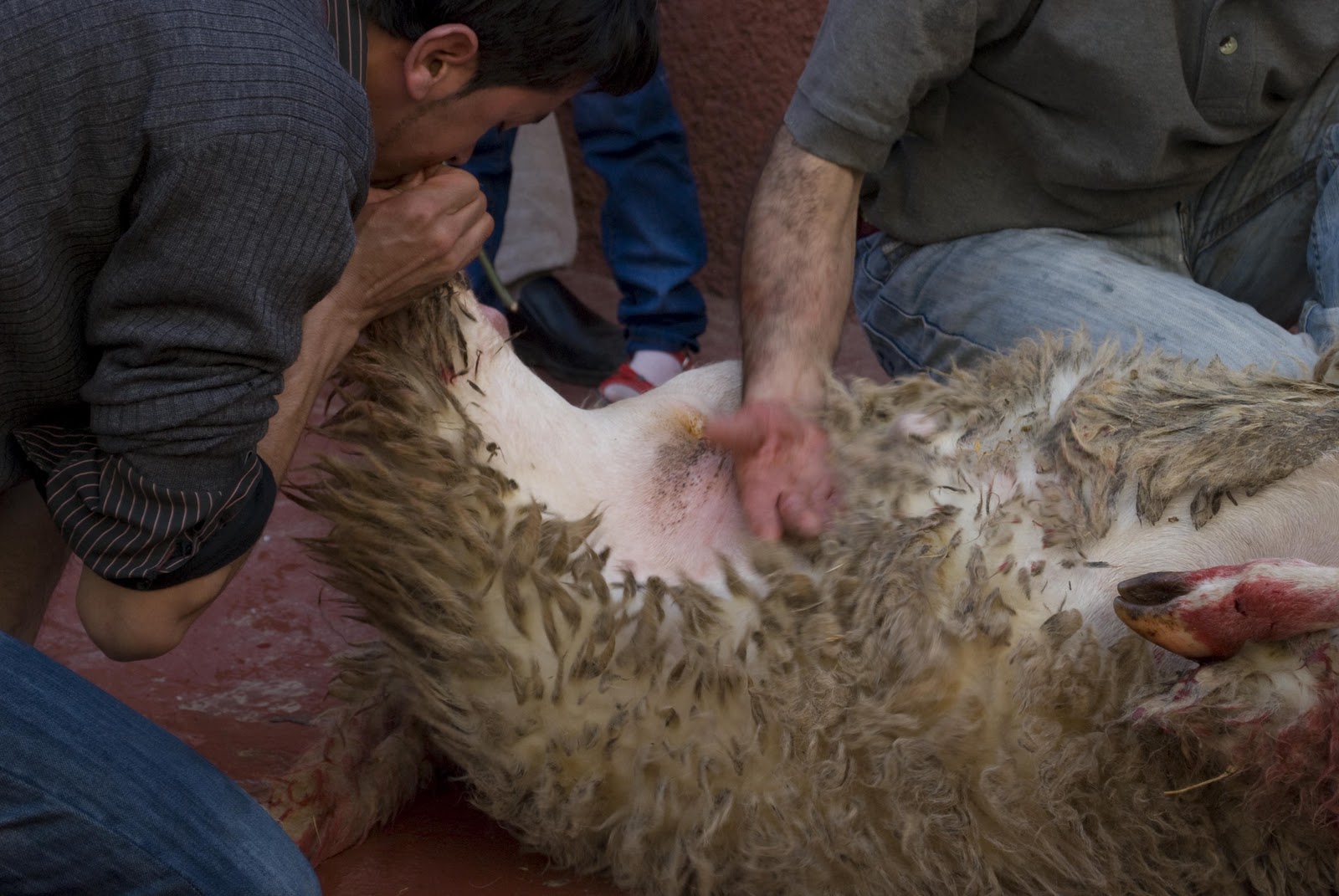
The skinning starts with the hindquarters. Here we can see the butcher inserting a sharpened reed into the skin just above the back left knee of the sheep. This reed puncture the skin, allowing the butcher to inflate the hindquarters, separating the skin from the meat and easing the skinning process.
The butcher's assistant orally inflates the hindquarters as the butcher strikes the lower abdomen to ensure equal air distribution.
The butcher makes his first incision behind the sheep's genitals.
Once the incisions are made the butcher breaks and removes the forelimbs of the sheep's hindquarters, so he can hang the sheep to skin it.
The butcher skinning the sheep. He works down, from the hindquarters to the front limbs.

Removing the skin from the front limbs and neck is a delicate process. A knife isn't used to avoid cutting into the meat. Instead, an incision is made near the sheep's shoulder. The butcher places his foot there and pulls the skin off with it.
Once the skin is removed, they begin to gut the animal. Here we see the butcher and his assistant removing the large instestine, which is not eaten, and the stomach.
Removing the small intestine, which is gathered together like rope.
The butcher standing next to the finished product.  

The sheep goes immediately from the butcher's knife to the grill. Cooking and eating comprise most of the Eid holiday activities, and my host said that they celebrate until all of the meat is gone. 

The first body parts to be prepared are the head and legs which are scorched over open flame as the sheep is skinned and butchered:


This scorching is only preparatory. My host father tended to the grill and scraped off the sheep's hair once it was burnt. Once clean, the head and legs are slow roasted overnight. We ate them the morning of the second day.

On the first day, the priority is to eat what will spoil quickest: the intestines and internal organs. My first delicacy was boulfaf: pieces of liver and/or kidney wrapped in fat and grilled on skewers. These were seasoned only with salt and cumin and were quite delicious. Next, we ate some small intestine, which was flavorless and mushy and not very appetizing. Last we ate heart, also seasoned only with salt and cumin.


Preparing the fat for boulfaf.

Liver and kidney, pre-boulfaf

My host's father, preparing boulfaf
Boulfaf on the grill.

Grilling the small intestine.
Heart. 

On the afternoon of Eid we traveled to my host's granfather's farm in 'l-Khizanah. There we feasted on mutton tagine and mechoui, Berber barbecue. It was nice to move away from organs to real meat.

My Eid al-Adha experience was eye-opening and incredibly impressive. Before last Wednesday, I had never seen a live animal slaughtered. It was intense. I'm not a very squeamish person, so I wasn't upset by the blood (even when some splattered on me). I didn't find it disturbing, but it was very real. It is one thing to buy a steak wrapped in cellophane from the supermarket and another to watch a sheep get gutted a few feet in front of you.

I don't think I will ever have a comparable culinary experience in my life. I ate meat so fresh that it was warm when it the fire. I ate liver for lunch and sheep face for breakfast. I was stuffed with mechoui, prune and mutton tagine, and mufawwur: roasted neck and leg meat with no sauce. In between meals there was kefta and an endless supply of harsha, a Moroccan cornmeal pancake, and olive oil. I will never eat so much meat in such a short period of time again. And it was all for the sake of family and friends.

On my last night, after a three course dinner left me stuffed beyond belief, I wondered aloud about why I continued to be plied with food. My host told me, "It's not about the eating. It's about the talking. Everyone has a sheep and it gets eaten whether you're here or not. But we do this because we want to spend time with you."


20 November 2010

Eid al-Adha in Morocco

I just got back from three days in Tahala where I celebrated Eid al-Adha with one of my students. It was an incredible experience that I will never forget. To put all of what happened into one post would be impossible, so I've decided to divide my description and thoughts of Eid into three separate ones. The first will describe the lead-up and preparation to the holiday. The second will take you step-by-step through the day of Eid, including pictures of the sacrifice. Some of these are graphic. The last will describe my impressions of the holiday.

What is Eid al-Adha? There are two official, major holidays on the Muslim calendar: Eid al-Fitr, which ends the month-long fast of Ramadan, and Eid al-Adha, also know as Eid al-Kabir, or the Big Eid. In Arabic, its name means the Celebration of the Sacrifice. The purpose of the holiday is to commemorate and reenact Abraham's near-sacrifice of his son Ishmael. Islam identifies with the traditions of Judaism and Christianity, so this is the same Abraham in the Old Testament, and the same event Jews and Christians know as the Binding of Isaac. In Islam, Ishmael replaces Isaac as Abraham's favorite son.

This is how it reads in the Qur'an:

So We gave him the good news of a boy ready to suffer and forbear. (101) Then when (the son) reached (the age of) (serious) work with him, he said: "O my son! I see in vision that I offer thee in sacrifice: now see what is thy view!" (The son) said: "O my father! do as thou art commanded: thou will find me if Allah so wills one practicing Patience and Constancy!" (102) So when they had both submitted (to Allah), and He had laid Him prostrate on his forehead (for sacrifice) (103) We called out to him "O Abraham! (104) "Thou hast already fulfilled the dream!"― thus indeed do We reward those who do right. (105) For this was obviously a trial― (106) And We ransomed him with a momentous sacrifice: (107) And We left (this blessing) for him among generations (to come) in later times: (108) "Peace and salutation to Abraham!" (109) Thus indeed do We reward those who do right. (110) For he was one of Our believing Servants.
This is the religious context that justifies Eid al-Adha, and most importantly, justifies the sacrifice of a live sheep. A lot has been written about whether such an act is humane. Seeing it firsthand, I can say that it is a pretty gruesome. But it is not senseless. This sacrifice is central to the whole celebration. Through it, Muslims  participate in Abraham's sacrifice, they embolden their faith by mimicking his. The sacrifice reaffirms God's mercy as well. Abraham's sacrifice was just a test, and Muslims are rewarded for their participation in the ritual just as Abraham was. The immediate reward is abundant food to enjoy with family and friends, as well as hasanat, credit for good deeds, that cancel out sins. In the long run, these help ensure a Muslim's place in Heaven. 
We may all have our opinions about this act, whether it is truly justified or justifiable, but we cannot overlook its tremendous meaning to Muslims. 

Like any major holiday, you can sense Eid's coming. Last weekend I went with my roommate and some other Fulbrighters to Sebta, a Spanish enclave on Morocco's northern coast, to renew our tourist visas. The train back to Fes was packed with Eid season travelers. My roommate returned a day later and reported he couldn't find a seat for one portion of his journey. He counted 17 people standing, packed like sardines, in the space between two of the railroad cars. In other words, this is a big deal. Moroccans travel back to their familial homes from all over the country. The train service provides extra trains. Bus companies and grand taxis work overtime to bring people from the country to the cities and vice versa. It's like traveling on Thanksgiving Day everyday during the week leading up to and after the holiday, but with a developing country's infrastructure.

The second sign of Eid is shopping. The most important purchase is, of course, the sheep, or hawli in Moroccan Arabic. Beyond the religious significance, the Eid sacrifice provides a family with a tremendous amount of fresh meat that is eaten almost immediately. As you will see, no part of the sheep goes untouched. The type of sheep and the manner in which it is purchased and cared for varies. 
There are six varieties of sheep in Morocco, all of which vary in size and price. The best, according to my hosts and other Moroccans, is the hawli ahmar, or 'red sheep', from the Atlas Mountains. A good one is about a year to a year and a half old. You can tell this by the size and color of the teeth. My host explained that you want a sheep with short, white teeth. In Arabic these are called sanan al-haleeb, literally 'milk teeth'. If the sheep doesn't have a full set of teeth, it is too young. And if they are yellow, then it is too old.
A good hawli ahmar costs around 2500 DH ($315.50), which is a big purchase. The Morocco's monthly per capita GDP is about 1850 DH ($232), and the average middle class monthly income is 6000 DH ($750). Some families buy sheep on credit or save up for one throughout the year. But others purchase only what they can afford. Smaller sheep, kbsh, and goats, 'anzi, are cheaper alternatives. Those who can't afford to purchase one of these can purchase meat from a butcher in advance or accept meat as charity from their neighbors. Religiously speaking, it doesn't matter that these people don't sacrifice a sheep. They get credit for the sacrifice. If they could afford to do so they would, and in Islam, intent is what matters. Large and/or wealthy families will sacrifice multiple sheep or even a cow. The latter is excessive. Beyond it being unnecessary, it seems difficult enough to me for a family to finish one 50kg sheep. How do you finish off a whole cow?

Traditionally, sheep are purchased off the street or in a market. Farmers and grazers bring their sheep to cities or souqs, either selling them directly or through agents. In Tahala we visited a large sheep market where many merchants were selling hundreds of sheep. Out in Fes this past Monday, I was harried by streams of men pushing their sheep down the street in carts. Shoppers would flag one down, negotiate a price and then drag or carry their future mutton home. This was last minute shopping, with a dash of Moroccan insanity. The flurry of handcarts, the bleating sheep, the haggling; it all makes arguing over the last Butterball in the supermarket on Thanksgiving Eve sound pretty tame.

Sheep are not all that is bought last minute. In Morocco, it is tradition to wear new clothes on Eid. Monday night, before leaving Fes I went shopping for a jalaba, a traditional Moroccan robe, to wear on Eid. I also bought new belgha, slippers. The streets were again packed with people doing the exact same thing. In this way, consumerism is an almost institutionalized feature of Eid. However, I did not sense it being similar to American Christmas. Granted, I don't have a television, so I don't know if or how Moroccan TV commercializes the holiday. Elsewhere there is evidence of commercialization: Morocco's national train company offers and advertises a sheep purchasing service. It's entirely possible that Eid's consumer culture is identical or similar to that of Christmas. But I doubt that. Eid is not a gift giving holiday. Moroccans do buy new clothes, but not in excess. Only my host's brothers wore new clothes and they were limited to one outfit or accessory. This may differ elsewhere, but in general, I think Eid's consumer culture drastically differs from what we're used to being associated with American holidays.
In preparation for my Eid in Tahala, I only formed a few expectations. Not having experience Eid before, I really didn't know what to think, and my host deliberately kept me "in suspense". But from what I knew of its role in Islam I expected the day to be very religious, especially the sacrifice. Looking back, while religion is an important feature of the celebration, to reduce Eid to a solemn religious expression is both inaccurate and does the holiday and its participants a great disservice. As you will soon see, the meaning of Eid is much deeper and richer.